
If you’d like to learn more about Might and Magic – Secret of the Inner Sanctum gameplay, I have a video series in the making, and all you need to know just below.
Might and Magic – Secret of the Inner Sanctum was, first and foremost innovative.
Real Turn-Based combat
Sanctum introduced actual turn-based, as opposed to phase-based combat found in the competition (Wizardry, Bard’s Tale, Wasteland…). Each character got a turn, which was executed immediately, whereas in phase based a set of actions are given to each character at the beginning of a round, that play out entirely with no opportunity to adapt before it finishes. It isn’t more realistic. (I could think of a half dozen of RPG mechanics that would suffer from being made more realistic, and many of them have been, like encumberance…. Yuck!) No more giving instructions to attack a specific enemy (or group of enemies) that result in no action at all due to their being destroyed by the first actions of the group.
Open Surface World
No more being stuck in a single city or dungeon… You got to see a (freakishly black) sky! And forests, mountains and swamps! Those were almost just aesthetical since you ended up with walls anyway, passable or not. But a quick look at the map and you were discovering a large, somewhat coherent world in your mind, at least.
Games like this made us old-timers more intelligent 😉
Combat options
All characters have the same options. Add ‘C’ast for spell casters.
‘A’ Attack: Fights the monster in position A. This saves you a prompt for selecting the opponent if you’re fine just bashing the first one that comes along. You’ll only want to do that if you’re pretty sure you’ve got the upper hand. Otherwise you mlight want to root out the most dangerous enemies first.
CTRL+A: Hold that down to instruct everyone in your party to ‘A’ttack. That means no casting, no shooting, no blocking… Use this when you know the enemy is far weaker and want to end the battle quickly.
In S&S Underworld, the archer actually shoots when using this, as requested by a player soon after release.
‘F’ Fight: Same as ‘A’ttack, only you are then prompted to select an opponent that is in melee range. Those are marked with a ‘+’. Only available if your character is also in melee range (this can be seen top left, under “ROUND #1”. Characters 1-6 are also marked with a ‘+’ when in melee range.
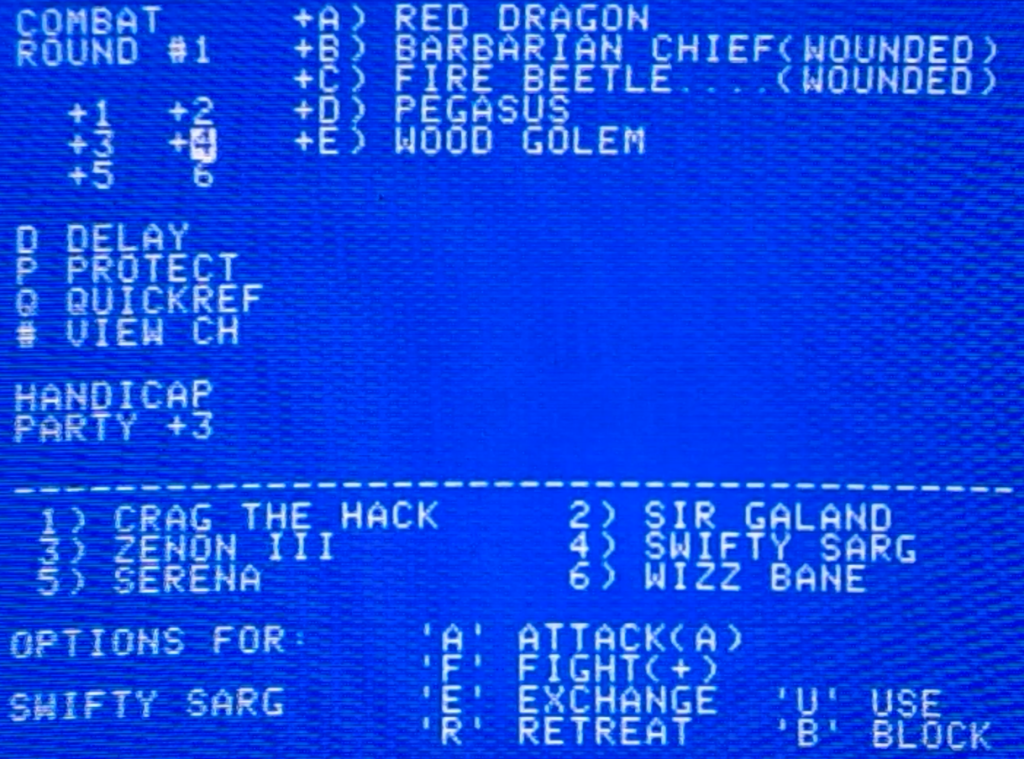
‘E’ Exchange: Trades places with another member of the party. This can get a wounded character out of melee, for instance.
S&S Underworld allows entering melee, leaving it, or everyone pressing forward or stepping back.
‘R’ Retreat: Tries to leave the battle entirely. If it succeeds, the battle ends and you run to the safest square on the map. Otherwise it fails and you continue getting destroyed, having lost a character’s turn to boot.
In Might and Magic – Gates to Another World retreating succeeds more often but only that one character escapes battle. In the end, anyone that wasn’t able to flee ends up dead. It is more realistic but if you can’t afford to have even one character resurrected at the temple it’s far more likely to be a lost cause.
‘U’ Use: Perhaps there is something in that character’s inventory that can save you (magic herbs, herbal patch come to mind quickest).
‘B’ Block: Increase the character’s Armor Class for a round. He/she can’t contribute? The least he/she can do is not getting hurt too bad and become a liability right?
‘C’ Cast: Select a level, then a spell number, followed either by an opponent if the spell is offensive, a party member for a buff or healing spell, or no selection if the spell has a global effect.
You can also modify ‘D’ Delay (I set it to 1 to be able to get a glimpse at what happens), view spells affecting the party with ‘P’ Protect, View the state of your party with ‘Q’ Quickref or press 1-6 to view a specific character sheet.
Non-combat options
Sanctum innovated by offering a large open world to roam freely in. That means, first and foremost…
Movement: When adventuring, there are of course the obvious movement options. for this you use the arrow keys. There was no WASD or key mapping at this juncture in gaming history, although some games will soon introduce IJKL.
Order: If you messed up your character selection at the Inn, you may want to use this option to set things right. There may be one or two instances in the game where this option is useful…
‘P’ Protect: Gives an overview of spells and conditions affecting the whole party (also available in Combat).
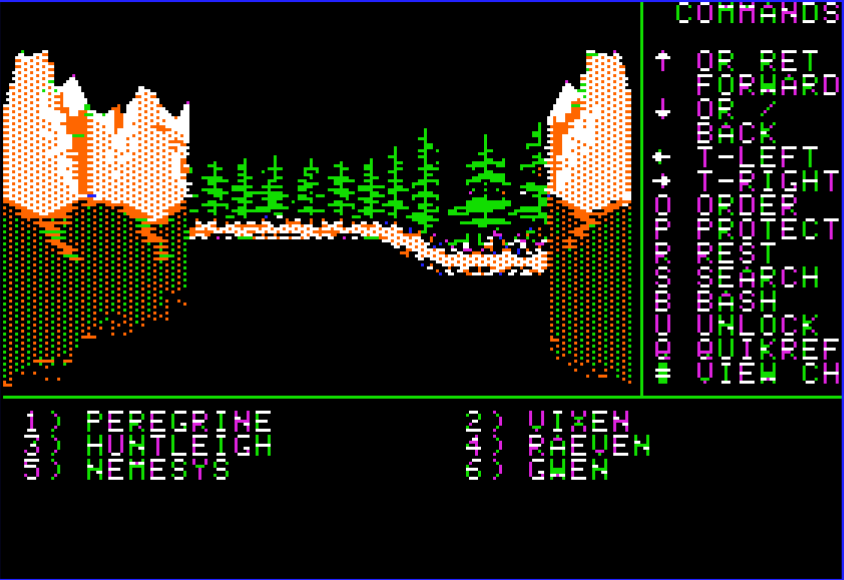
‘R’ Rest: Replenishes HP and SP at the expense of a day (age can become an issue) and a unit of food per character. There’s always the risk of interruption, which means starting battle with an unrested party and a few sleeping party members.
‘S’ Search: Searches the local square for treasure. Don’t forget to do this after every battle. It isn’t automatic.
‘B’ Bash: Tired of picking locks? Use your head instead!
‘U’ Unlock: Got a headache bashing? Ask your robber to do something for a change.
‘Q’ Quickref: An overview of the party. Available in Combat.
Questline
Save Alamar, get the Gold Key, end the game in Castle Doom.
Then there are a few side quests. Some are given by kings, and some aren’t really quests as they are things you happen to be able to do with no one actually asking you to do it. Like using your sign at a roulette stand, finding a Coral key, destroying iconinc monsters seen on the map (dodging a Dancing Sword for instance).
VARN (Vehicular Astropod Research Nacelle) is full of surprises and tons of fun!